Your guide to elected positions
What do the elected officials on your ballot actually do?
On October 11th, New Orleans will have a municipal election to elect a new Mayor, City Council, Sheriff, Assessor, and Clerk of Criminal District Court. In order to make an informed vote, it’s important to understand what’s at stake, and what each position is responsible for. Here’s a rundown on each position, and qualities of a good candidate.
Mayor
What does the Mayor do?
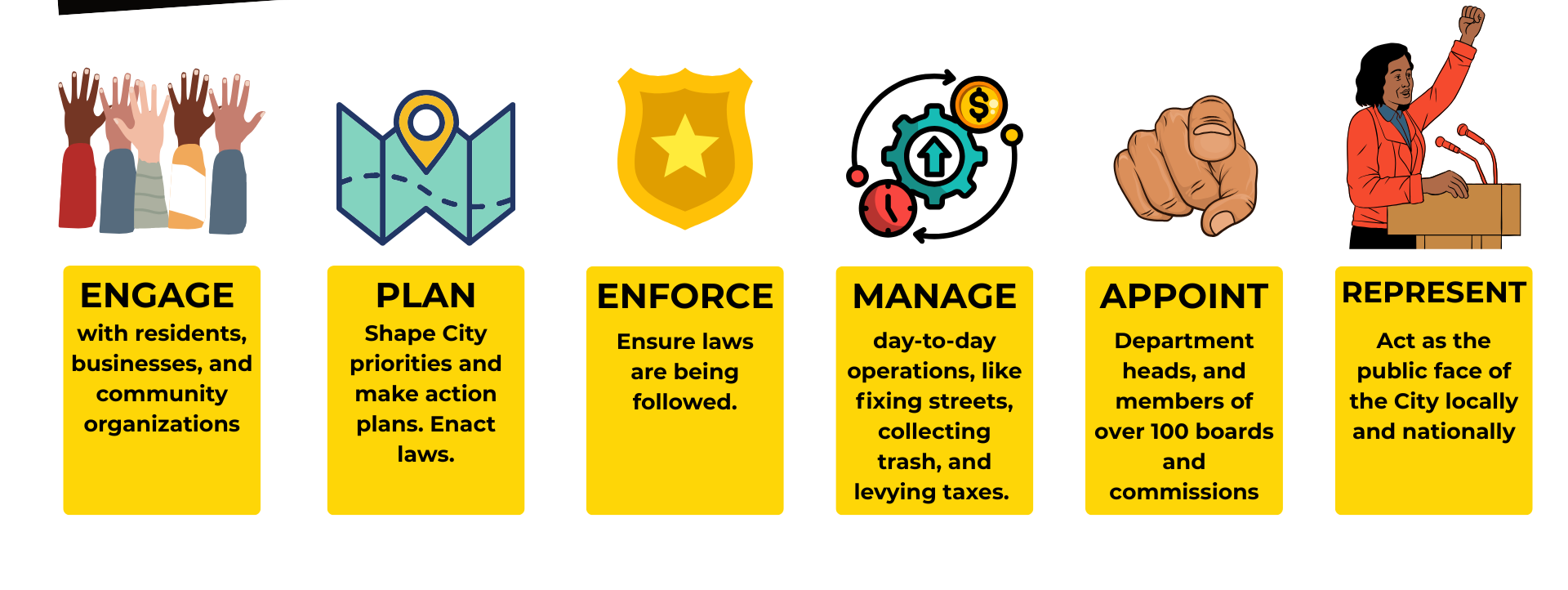
The Mayor and the people who work for them are the Executive Branch of the local government. They are responsible for engaging with residents, shaping city plans and priorities, enforcing laws, appointing department heads, and managing day-to-day operations of the City, like fixing streets, collecting trash, issuing permits and collecting taxes. The Mayor is the public face of the City locally and nationally.
What makes a good Mayor?
Look for a candidate who not only has a vision, but also the skills and character to lead with integrity, effectiveness, and equity. Here's a list of key qualities and skills to look for in Mayoral candidates:
🧭 Vision & Leadership
Clear vision for the city’s future
Ability to set priorities and make tough decisions for the long-term good
Inspires trust and collaboration across neighborhoods, sectors, and political lines
🧠 Competence & Experience
Strong understanding of city government, budgeting, and public policy
Proven ability to manage large teams and complex systems
Track record of getting things done—especially in government. If they don’t have government experience, an understanding of what makes government, nonprofit, and business management different.
🤝 Integrity & Accountability
Honest and transparent
Welcomes public input and explains decisions clearly
Willing to admit mistakes and course-correct
📣 Communication & Community Engagement
A good listener who regularly connects with residents, not just during elections
Skilled at bringing people together, especially across divides
Values and elevates grassroots voices—especially those most impacted by city policies
⚖️ Equity & Inclusion
Deep understanding of racial and economic disparities in New Orleans
A commitment and a plan to close opportunity gaps, not just talking about them
Actively works to build a city where everyone can thrive, not just the well-connected
🔧 Problem-Solving & Innovation
Focused on evidence-based solutions
Open to new ideas and partnerships, including with community leaders and researchers
Seeks systemic solutions, not just short-term fixes
City Council
What does the City Council do?
City Council is the Legislative Branch of local government. New Orleans has 5 District council members (See the district map here) and 2 At-Large council members who represent the entire City. You will have 3 seats on your ballot — your district council member (A, B, C, D, or E) and both at-large seats (1 and 2).
Councilmembers are responsible for:
Making laws
Approving the City Budget, including changes to the budget throughout the year.
Overseeing Land Use & Zoning
Approving Mayoral Appointments & Contracts
Regulating Entergy New Orleans
Councilmembers also represent and advocate for their constituents, helping residents navigate city services and policies. They have the power to investigate city departments and agencies, issue subpoenas, and demand accountability.
What makes a good City Council Member
A good City Councilmember is more than just a policymaker—they’re a community advocate, a watchdog, a collaborator, and a bridge between the people and the government.
👂Accessible & Responsive to the Community - Your Council member is your most direct representative in government. It’s important that they understand your community’s needs, are a good listener, and are consistent in showing up.
🧠 Knowledgeable & Prepared - It’s important for them to understand the city's budget, policies, and land use rules. Look for someone who’s done their research, and comes to meetings prepared.
📈 Transparent & Accountable - A good council member shares updates, explains their reasoning and owns their decisions.
📢 A Strong Advocate - Council members have a lot of power, and can use that to speak up for underrepresented neighborhoods and communities. Make sure they’re aligned with your values, and able to speak up for what you believe in.
🤝 Collaborative - Your council member is one of seven votes, so they’ll have to work well with others to get the job done.
⚖️ Ethical - The council has a lot of power. It’s important that they can follow the rules, avoid conflicts of interest, and keep the public interest at heart.
✅ Visionary & Practical - We need legislators with a vision for a better New Orleans, and the practical skills to get us there.
Orleans Parish Sheriff
What does the Sheriff do?
Sheriff manages the jail and the people in custody at Orleans Parish Justice Center (OCJC). Unlike in other counties in the country, the New Orleans Sheriff does not generally handle street-level policing.
People in custody at OCJC are people awaiting trial in Orleans Parish, or serving short sentences. The Sheriff is also responsible for transporting them to and from the court.
What makes a good Sheriff?
🏛️ Justice-Focused - Prioritizes rehabilitation and alternatives to jail.
👥 Treats People with Dignity - Ensures humane conditions, health care, and reentry support.
🪟 Strong & Transparent Manager - Runs the jail effectively, constitutionally, and safely. Uses resources wisely, and shares data with the public.
🤝 Community-Minded - Works with families and service providers to improve public safety.
⚖️ Fair & Ethical -Carries out civil duties with integrity and compassion.
Assessor
What does the Assessor do?
The Orleans Parish Assessor is responsible for determining the value of all property in New Orleans for tax purposes. This office plays a key role in how much property owners pay in taxes each year, and has huge implications on fairness, housing affordability, and public trust.
Determines Property Value - assesses the fair market value” of residential, commercial, and industrial properties. This value is used by taxing authorities to calculate your property tax bill. They do not set the tax rate, that’s done by the taxing bodies (the City, School board, RTA, etc.).
Maintains Property Records - Keeps public records on property ownership, location, square footage, use, and value.
What makes a good Assessor?
When we elect a new Assessor, we’re choosing how fairly taxes are shared, how neighborhoods are shaped, and how well our public systems are funded. A good assessor has:
⚖️ Fairness & Accuracy - Property taxes fund essential City services. If properties are under- or over-valued, it affects how much revenue is available for these services—and who pays for them.
🔍 Strong Systems of Accountability & Management - The Assessor plays a role in how tax relief tools like the homestead exemption are applied. This can have major implications on housing affordability for low-income homeowners.
🪟 Transparency - A good Assessor is accountable, makes the process clear and accessible, and ensures residents understand how their property is being valued and why.
Clerk of Criminal Court
What does the Clerk of Criminal Court do?
The Clerk of Criminal District Court is responsible for the administrative backbone of the criminal court system in New Orleans. Key duties include:
Maintaining court records for all felony criminal cases
Managing the court docket—scheduling hearings and trials
Processing legal filings, subpoenas, and motions
Supporting jury selection and issuing summonses
Handling court fees, fines, and documentation
Overseeing elections in Orleans Parish (this is unique to New Orleans!) - the clerk’s office qualifies candidates for office in all municipal, parish, and state legislative elections; trains election commissioners; and counts the votes.
The Clerk does not decide guilt or innocence but plays a crucial role in ensuring the justice system runs efficiently and fairly.
It’s an unseen, but very important role in the criminal legal system. Accurate, timely, and transparent records are vital for accountability and trust in the legal system. Delays in paperwork or scheduling can slow down trials, delay justice, or even cause cases to be dismissed.
What makes a good clerk?
The Clerk can help make criminal justice data more accessible—important for advocates, researchers, and policymakers working on reform. A good clerk is:
Organized & Tech-Savvy - Can modernize outdated systems and improve access to records
Transparent & Fair - Committed to public access and serving all residents equally
Detail-Oriented & Efficient - Keeps accurate records and minimizes court delays
Accountable & Ethical - Manages court data with integrity and impartiality
Committed to Justice System Access - Understands the barriers faced by defendants, victims, attorneys, and families—and works to reduce them