Residents’ Guide to the
2026 Fall Election
Everything you need to inform your vote this November.
Get ready to vote on Nov. 3rd.
New Orleans needs leadership now more than ever. Morale is low, population is declining, and civic distrust is at an all time high. The good news? YOU have a say in what happens next! Here’s your hub to inform your vote in the November 2026 Elections.
Early Voting starts Oct 20!
Orleans Parish voters can vote at any early voting location from 8:30am-6pm daily from October 20-27th (closed on Sunday). Locations:
City Hall, 1300 Perdido St. Rm. #1W24
Algiers Courthouse, 225 Morgan St. Rm. #105
Voting Machine Warehouse, 8870 Chef Menteur Hwy
Lake Vista Community Center, 6500 Spanish Fort Blvd. 2nd Floor
Who is running?
This election includes our representatives at the Federal level in both the House and the Senate, our representative on the Public Service Commission and Board of Elementary and Secondary Education, plus many local judges. The information below is from the Power Coalition for Equity & Justice’s Sample Ballot for Orleans Parish.
-
We have 2 senators that represent the whole state. One of the positions is up for grabs now.
Jamie Davis - Democrat
Julia Letlow - Republican
-
The House of Representatives is part of the legislative branch of the U.S. Government that makes laws. Representatives introduce bills and resolutions, offer amendments and serve on committees. The House has several powers assigned exclusively to it, including the power to initiate revenue bills, impeach federal officials, and elect the President in the case of an electoral college tie.
Randall Arrington – Republican
E. ‘Liddy’ Glass – No Party
Lauren Jewett – Democrat
Steve Scalise – Republican
-
The House of Representatives is part of the legislative branch of the U.S. Government that makes laws. Representatives introduce bills and resolutions, offer amendments and serve on committees. The House has several powers assigned exclusively to it, including the power to initiate revenue bills, impeach federal officials, and elect the President in the case of an electoral college tie.
Lisa Ballay – Libertarian
Walter ‘Rocky’ Beach – No Party
Troy A. Carter, Sr. – Democrat
Renada ‘Honey’ Collins – No Party
Peter Williams – Republican
-
The Louisiana Public Service Commission (LPSC) is an independent regulatory agency dedicated to serving the public interest by assuring safe, reliable, and reasonably priced service from public utilities and motor carriers. The LPSC consists of five elected Commissioners who serve overlapping terms of six years.
Responsibilities: The PSC decides:
How much utilities can charge you
How much profit utility companies can make
Whether companies can build new power plants and pass the cost on to customers
Whether to fund programs that help lower your bills, like energy efficiency upgrades
Why it matters: Your power bill, how quickly the lights come back after a storm, and what kind of energy powers Louisiana all depend on decisions the PSC makes. When you vote for a commissioner, you’re choosing who looks out for customers when utilities ask for more money.
If you live in New Orleans, the City Council regulates your gas and electric bills. But the PSC still affects you. It oversees some other services in the city, and it makes decisions about the regional power grid that New Orleans shares with the rest of the state. This year, the District 1 race appears on ballots in Plaquemines, St. Bernard, St. Tammany, Tangipahoa and Washington parishes and parts of Jefferson, Livingston, Orleans and St. Charles. So some New Orleans voters will see it, and others won’t.
Stephanie Hilferty – Republican
Christopher ‘Chris’ Justin – No Party
Connie Norris – Democrat
-
The Board of Elementary and Secondary Education (BESE) is made up of 11 members, eight are elected from the BESE districts, and the other three are appointed by the Governor and confirmed by the State Senate.
Responsibilities: BESE has the responsibility for governing all Louisiana elementary and secondary schools; special schools for the deaf, blind, and physically handicapped; and educational units within the state’s correctional institutions and mental facilities.
BESE has the authority to create policies that govern the statewide operations of public and non-public schools, to administer the budget for educational programs and services at those schools, and to conduct administrative hearings to resolve any conflict concerning its policies and actions. Some of the many specifically defined duties assigned to this board by law include approval of certification requirements, policies for assessment and evaluation of teachers, administrators and students, approval of textbooks, and administering the state’s charter school program.
Joseph Cao – Republican
Angela Hershey – Democrat
-
District court judges make important decisions in civil and criminal cases (mainly felonies and property-related matters) that impact not only the parties who appear in court for specific cases, but also the community at large. They also handle appeals of criminal cases tried by city, municipal, and traffic courts (with a few exceptions).
Judge, Civil District Court, Division L
Warren McKenna III – Democrat
Candace N. Newell – Democrat
Judge, Civil District Court, Division M
Stephanie Bridges – Democrat
Shawn Lindsay – Democrat
Judge, Civil District Court, Domestic Section 1
Michael ‘Mike’ Hall – Democrat
Marie Williams – Democrat
Judge, Criminal District Court, Section D
Kimya Holmes – Democrat
Simone Levine – Democrat
Judge, Criminal District Court, Section H
Camille Buras – Democrat
Leon Roché – Democrat
-
Magistrate Judges are the first judges you see, and they determine how your case moves forward. They also often conduct mediations, resolve discovery disputes, and decide a variety of motions. They determine whether criminal defendants will be detained or released on a bond, and may appoint counsel for defendants.
Chanel Robinson Debose – Democrat
Juana Marine Lombard – Democrat
-
What does a constable do?
A constable is an elected officer who works for the local city court or justice of the peace court. Their main job is to carry out the court’s orders. That includes:
Delivering court papers, like summonses and warrants
Carrying out evictions
Collecting money owed through wage garnishments
Helping keep the peace
Why it matters: If you’re ever in a dispute with a landlord or a debt collector, the constable’s office is often the one that carries out what the court decides.
Kristi Boissiere August – Democrat
Willie Jones – Democrat
Research Your Ballot
Resource Roundup
The below resources are from other organizations and news outlets. We provide them here to help voters do their research.
They don’t represent CBNO’s stance on any issue or candidate.
-
![Antigravity Voter Guide - CBNO]()
Antigravity Guide
Antigravity’s Guide to the ballot includes information about each candidate and ballot measure.
-
![]()
Verite Candidate Surveys
Verite News contacted every candidate in every competitive race to ask the same set of questions tailored to each office.
-
![]()
PutHousingFirst Ballot
Greater New Orleans Housing Alliance’s Put Housing First scorecards and positions on propositions.
-
![]()
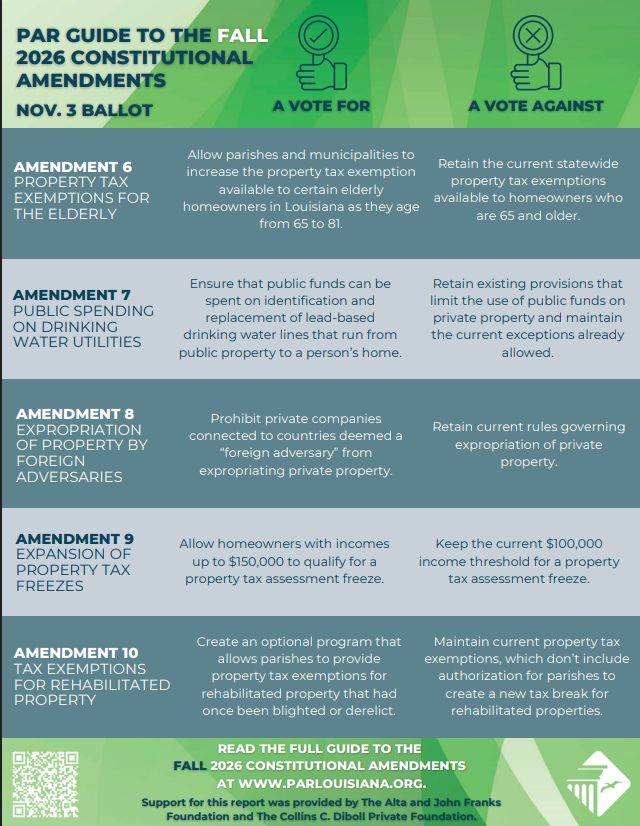
PAR Louisiana Guide to the Constitutional Amendments
This nonpartisan, educational review helps you understand the issues and the proposed changes for each Statewide constitutional amendment proposal.



Ballot Measures - November 3
(Amendments, and other items on your ballot besides elected positions)
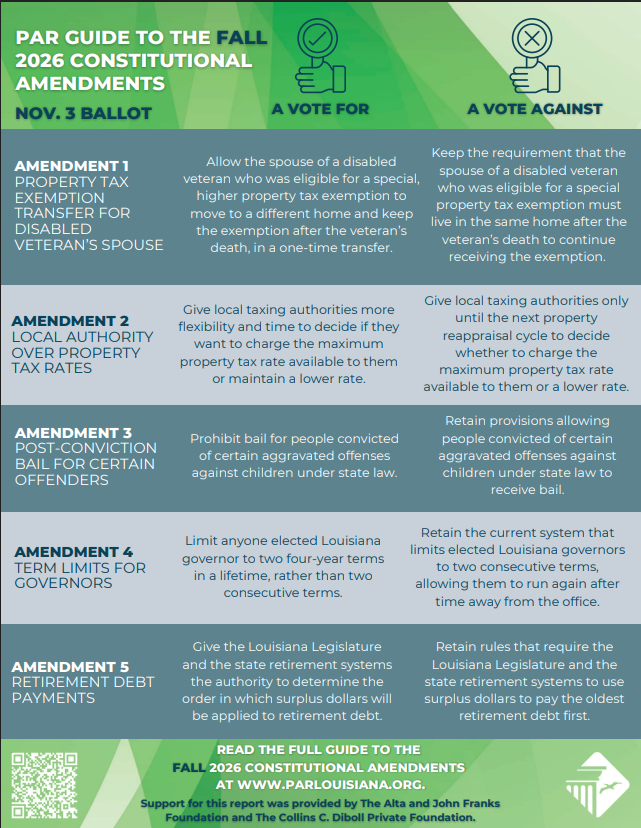
There are 10 Louisiana State Constitution Amendments on your ballot. We recommend the PAR Louisiana guide to the constitutional amendments, which includes detailed explanations of what the current state of the policy is, what would change, and an argument for and against each amendment.
Constitutional Amendments
Parishwide Charter Amendment - Keep City spending within the Budget
-
Shall Section 6-103 of the Home Rule Charter of the City of New Orleans be amended (i) to prohibit allotments, reallotments, or transfers of budgeted operating funds that will cause, or that are reasonably anticipated to cause, expenditures from any funding category for any department to exceed the amount appropriated for that fiscal year, unless an amendment to the operating budget ordinance reflecting the increase has been adopted and approved, (ii) to require monthly reports to the City Council regarding expenditures to assess whether spending remains in line with the approved budget, and (iii) to prohibit the approval of any requisition, purchase order, voucher or check that would cause, or that is reasonably anticipated to cause, any category of expenditures in the approved annual operating budget to exceed the appropriated amount for that fiscal year, all as more fully described in Ord. No. 30553, M.C.S.?
-
What it is
Every year, the City Council passes a budget. It’s like an allowance plan: each city department (police, fire, parks, and so on) gets a set amount of money for different kinds of costs, like paychecks or supplies. This amendment would make it a rule that departments can’t spend more than their share unless the Council votes to change the budget first. If voters approve, the change would take effect January 1, 2027.Present situation
The City Council approves the budget, but the mayor’s administration can move money around and pay bills even when a spending category goes over its limit. Problems may not show up until later.Why it’s on the ballot
When the current budget crisis began in 2024 and 2025, it revealed some major issues with the way the Administration manages City spending. Since the Administration was allowed to move money without Council approval, they didn’t know about the crisis until it was too late to stop it.Proposed change
The amendment does three things:No moving money that causes overspending. The city can’t shift money in a way that will push a department past what it was given, unless the Council first passes a budget change.
Monthly check-ins. The administration must report to the Council every month on how much has been spent, so everyone can see if spending is on track.
No signing off on overspending. City officials can’t approve purchases, bills, or checks that would push any spending category over its limit.
A YES vote means departments couldn’t spend more than their budget without Council approval, and the Council would get monthly spending reports.
A NO vote means the current rules stay the same.
-
Vote YES. This amendment would strengthen checks and balances around City spending.
This could prevent a future crisis. It treats the budget like a real limit, and creates opportunity for public dialogue when that limit isn’t enough.
Better transparency - Monthly reports catch problems early, before they become a crisis. Adhering to this charter change would force the City to make City budgets and spending a lot more transparent. More transparency not only paves the way to accountability, it also gives residents the opportunity to push for a more equitable budget.
More accountability - The Council, which voters elect to approve the budget, gets a clearer say when plans change. They would have to do that in a public meeting.
Durable solution - Putting it in the charter makes it harder for future leaders to ignore or undo.
Neighborhood-Specific Propositions
The following will only appear on your ballot if you live in the designated neighborhood:
-
Kenilworth Improvement District Proposition
What it says:
Shall the City of New Orleans levy an annual fee on each parcel located within the Kenilworth Improvement District (“District”), as delineated by La. R.S. 33:9078(C), in the amount of $225, for eight years, beginning January 1, 2027 and ending December 31, 2034, which is estimated to generate $143,500 annually, to be used exclusively for the purpose of promoting, encouraging, and enhancing the security, beautification, and overall betterment of the District, except a 1% City collection fee, and if used for additional law enforcement or security personnel and their services, such personnel and services shall be supplemental to and not in lieu those provided by the New Orleans Police Department?
What it means:
The Kenilworth Improvement District is asking to create a parcel fee of $225 per parcel annually.
It would run for 8 years (Jan 1, 2027 to Dec 31, 2034) if approved.
Proceeds are used for security patrols, beautification, and “overall betterment” of the district.
A YES vote means:
Property owners in the district will pay $225/year for the next 8 years.
A NO vote means:
The fee would not be charged.
-
What it says
Shall the City of New Orleans levy an annual flat fee on each improved parcel within the Lake Bullard Neighborhood Improvement District (“District”), as delineated by La. R.S. 33:9080(B), in the amount of three hundred fifty dollars, for eight years, beginning January 1, 2027 and ending December 31, 2034, which is estimated to generate $98,000 annually, to be used exclusively for the purpose of promoting and encouraging the beautification, security, and overall betterment of the District, except a 1% City collection fee, and if used for additional law enforcement or security personnel and their services, such personnel and services shall be supplemental to and not in lieu of personnel and services provided by the New Orleans Police Department?
What it means:
Lake Bullard is the New Orleans East neighborhood bounded by Bullard Avenue, Dwyer Road, the Berg Canal, and Lake Forest Boulevard. Homeowners there pay a yearly fee that funds neighborhood security, beautification, and other improvements.
This proposition asks voters in the district whether to charge that fee for eight years, from 2027 through 2034. It would be a flat $350 per year on each property with a building on it. Empty lots would not be charged.
A yes vote means
The fee is charged from 2027 through 2034 at $350 per property per year. The district has funding for patrols and improvements for those eight years.A no vote means
The fee is not charged starting in 2027. The district would lose this funding unless voters approve a fee in a future election.
-
Lakewood East Security & Neighborhood Improvement
What it says:
Shall the City of New Orleans levy a flat annual fee on each parcel located within the Lakewood East Security and Neighborhood Improvement District (“District”), as delineated by 33:9080.3(B), in the amount of $300, for eight years, beginning January 1, 2027 and ending December 31, 2034, which is estimated to generate $27,600 annually, to be used exclusively for the purpose of promoting and encouraging the beautification, security, and overall betterment of the District, except for a 1% City collection fee, and provided that, if used to fund additional law enforcement or security personnel and services, such personnel and services shall be supplemental to and not in lieu of those provided by the New Orleans Police Department?
What it means:
The Lakewood East Crime Prevention & Improvement District is asking for a parcel fee of $300 per parcel annually, for 8 years. (This is an increase from earlier max/limits for that District.)
Use: to fund crime prevention and improvement services for Lakewood East residents: additional security/police patrols, possibly beautification/etc.
A YES vote means:
Property owners in the Lakewood East district will pay $300 per parcel a year for the 8‐year period.
The additional revenue will go to fund public safety, crime prevention, community improvements in Lakewood.
A NO vote means:
The fee is not approved; the district doesn’t get that funding.
-
Lake Willow Subdivision Improvement District Proposition
What it says:
Shall the City of New Orleans levy a flat annual fee on each parcel located within the Lake Willow Subdivision Improvement District (“District”), as delineated by La. R.S. 33:9073(B), in the amount of $300, for three years, beginning January 1, 2027 and ending December 31, 2029, which is estimated to generate $51,400 annually, to be used exclusively for the purpose of promoting and encouraging the beautification, security, and overall betterment of the District, except for a 1% City collection fee, and provided that, if used to fund additional law enforcement or security personnel and services, such personnel and services shall be supplemental to and not in lieu of those provided by the New Orleans Police Department?
What it means:
Lake Willow Subdivision Improvement District is asking for a parcel fee of $300 for three years.
Purposes include enhanced security/policing, beautification, district improvements.
A YES vote means:
The fee is approved; district gets funding for crime prevention & improvement work for 3 years.
A NO vote means:
No new fee; district won’t have that revenue.
-
Lake Oaks Subdivision Improvement District Proposition
What it says:
Shall the City of New Orleans levy an annual parcel fee on all taxable real property within the Lake Oaks Subdivision Improvement District (“District”), as delineated by La. R.S. 33:9075(B), in an amount not to exceed eight hundred dollars, with the precise amount as authorized by duly adopted resolution of the Board of Commissioners of the District, currently specified as five hundred dollars and estimated to generate $137,500 annually, for four years, beginning January 1, 2027 and ending December 31, 2030, to be used exclusively for the purpose of promoting and encouraging the beautification, security, and overall betterment of the District, except a 1% City collection fee, and if used for additional law enforcement or security personnel and their services, such personnel and services shall be supplemental to and not in lieu of personnel and services provided by the New Orleans Police Department?
What it means:
Lake Oaks homeowners pay a yearly fee that funds neighborhood security patrols, beautification, and other improvements. The current fee ends December 31, 2026. This proposition asks voters in the district whether to continue it for four more years, and increase it.
The fee would start at $500 per property. The district’s board could raise it up to $800 per property without another election.
A yes vote means
The fee continues through 2030, starting at $500 per property per year, with the board able to raise it to as much as $800. The district keeps its funding for patrols and improvements.A no vote means
The fee ends after 2026. The district would lose this funding unless voters approve a new fee in a future election.
