New Orleans has a $100 million gap in its 2027 budget. To help close it, the City may raise some property tax rates. This is called a “millage roll forward.” The City Council will hold a public hearing on Thursday, November 5, at 10 a.m (here’s the meeting details & agenda). Here’s what you need to know before you go.
What is a millage?
A millage is a property tax rate. One mill means you pay $1 in taxes for every $1,000 of your property’s taxable value.
How is my tax bill figured out?
The Assessor starts with your property’s market value. That’s about what it would sell for.
They take 10% of that number. This is your assessed value. (Commercial buildings use 15%.)
If you own your home and live in it, they subtract $7,500 from the assessed value for the homestead exemption.
Then they use this formula: Taxable value × (millage rate ÷ 1,000) = your tax bill
Example (without a homestead exemption):
A $250,000 rental home has a taxable value of $25,000. The 2026 millage rate is 128.48 mills.
$25,000 × (128.48 ÷ 1,000) = $3,212 a year
What is a millage roll forward?
Every millage rate has a maximum limit set by voters. The City can charge up to that limit, but not more.
Every four years, the Assessor updates property values. When values go up, Louisiana law automatically lowers millage rates, so the City collects about the same amount of revenue overall. This is called a roll back. After a roll back, the rates sit below the limit voters approved. A roll forward raises them back up to that limit.
For example, the City’s main operating tax is currently 12.23 mills. Voters approved up to 13.91 mills. A roll forward would raise it to 13.91.
A roll forward doesn’t need a public vote, since voters already approved the higher limit. But the City Council must hold a public hearing and get a two-thirds vote to pass it.
What’s being proposed now?
The City wants to raise 13 of its property taxes by a total of 7.44 mills. This would bring in about $42 million more a year to the City’s revenues. The Council could also choose a smaller increase that raises about $21 million, or no increase at all. The City hasn’t fully rolled forward its millages since 2015.
If the City Council approves a roll forward, only City taxes would change. Taxes for the School Board, Sewerage & Water Board, city debt, and law enforcement district would stay the same.
How much would my bills go up?
If you own your home and have a homestead exemption, a full roll forward would add about:
$150,000 home — $67 more per year
$200,000 home — $104 more per year
$250,000 home — $141 more per year
$300,000 home — $178 more per year
$400,000 home — $253 more per year
$500,000 home — $327 more per year
$750,000 home — $513 more per year
$1 million home — $699 more per year
If you own a rental or other property with no homestead exemption, you’d pay more. Our $250,000 rental example would go from $3,212 to $3,398 a year, an increase of $186.
If you rent, you won’t get a tax bill, but your landlord could raise your rent to cover the increase.
The City has created a calculator tool to help residents understand how their property tax bills would be affected by the proposals.
What would the increased tax revenue fund?
The Moreno Administration presented to City Council on October 22nd to explain their request and what programs they would restore funding to if the millages were rolled forward. These are programs that the Mayor chose not to fund in her initial 2027 Proposed Budget. If the Council decides not to roll forward the millages, they will have to propose alternate cuts to fund these programs in the 2027 Budget.
Low Barrier [Homeless] Shelter: $5M
Right to Counsel (free lawyers for tenants facing eviction): $2.5M
Sanitation Services: $2.4M
Mardi Gras Parade Cleanup: $1.75M
Parks and Parkways Funding: $0.894M
Neighborhood Engagement Funding: $0.393M
Fire Department Funding: $8.5M
NOPD Civilian Staffing / Traffic Incident Response: $5.6M
Maternal Health Funding: $0.379M
Total: $27.4 Million
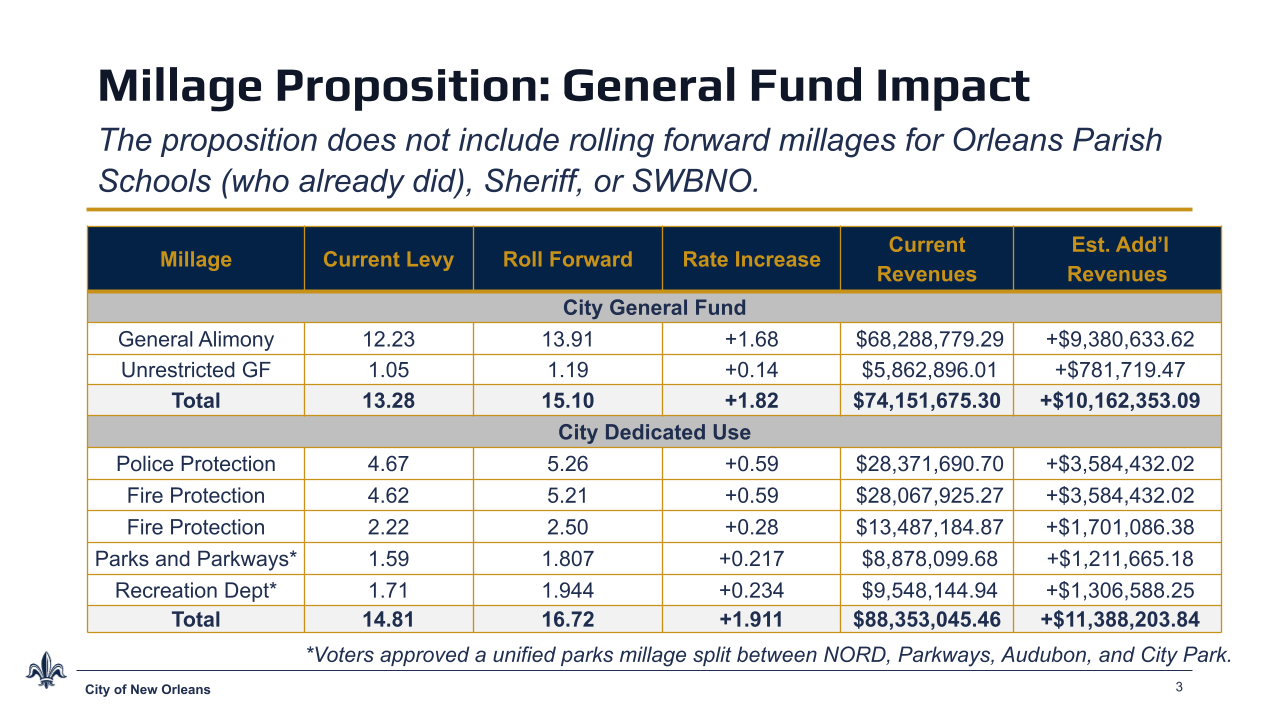
Each of these millages, if rolled forward, would go toward the General Fund. About $10.1 Million would be for any use, while about $11.3 Million would be dedicated to police, fire, parks, and NORD.
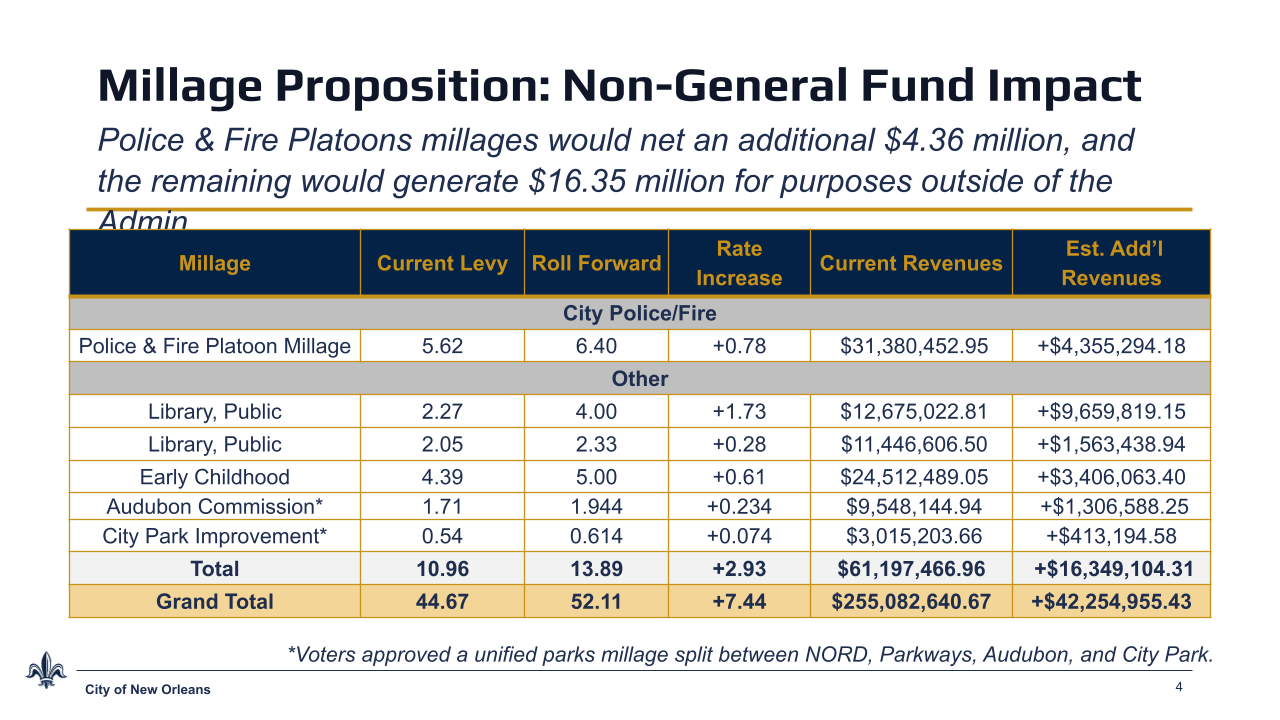
These millages would go toward “Non-General Funds.” The Audubon Commission and City Park Improvement millages would go to those external agencies.
How can I have my say?
Come to the public hearing:
Thursday, November 5, 10 a.m.
City Council Chamber, Room 1E07
City Hall, 1300 Perdido St.
Or submit an online public comment by 8am Thursday November 5th.