What’s a bond?
With the November election fast approaching, there’s a lot of talk about municipal bonds. But what exactly is a bond, and why is it on your ballot? Here’s everything you need to know.
What Is a Municipal Bond?
A municipal bond (often called a “bond” on your ballot) is a way for a city or parish to borrow money to pay for big community projects — things like fixing streets, improving drainage, building new schools, or repairing playgrounds. Cities usually can’t afford to pay for these large projects all at once out of their regular yearly budget. So instead, they borrow the money now and pay it back slowly over time, kind of like a mortgage on a house.
When you vote on a bond, you’re giving the city permission to borrow money for specific public projects.
Why Do Cities Use Bonds?
This is a normal and common way for cities to fund major projects. Most cities in the U.S. use bonds regularly because:
Big projects cost a lot and can’t fit into one year’s budget.
Borrowing allows the city to start the project now instead of waiting many years to save up.
It also spreads the cost over time, so the people who benefit in the future (like students using a new school or residents using new drainage systems) help pay for it gradually through taxes.
Who Buys the Bonds — and Why?
When voters approve a bond, the city is allowed to sell the bonds — which means offering them for sale to people and institutions who want to invest.
Bonds are bought by banks, investment funds, and individual investors.
They buy them because cities almost always repay what they owe, and the interest they earn is often tax-free.
In return, the city gets the money it needs upfront to start projects right away.
Types of Bonds
Not all bonds are the same. Here are the two main kinds:
General Obligation (GO) Bonds - GO bonds are repaid through property taxes or other city revenues, and backed by the city’s full credit and taxing power. Usually require voter approval. They’re often used for projects like street repairs, drainage upgrades, library renovations. They’re repaid over a longer period (like 30 years).
Revenue Bonds - Revenue Bonds are like a bridge loan, that are repaid with money from a specific project or service — not general taxes. For example, a City might borrow money to pay upfront for costs that will be reimbursed by a grant from the federal government.
What Bond Money Can (and Can’t) Be Used For
Bond money comes with strict rules.
It can only be used for the purposes listed on the ballot — like streets, drainage, or parks.
It cannot be used for regular operating expenses such as salaries, rent, or supplies that are unrelated to the project.
Bonds usually fund capital projects — things that last for many years.
That means when you vote “yes,” you’re approving borrowing for specific improvements, not giving the city a blank check.
How Bonds Affect Taxes
Bonds are repaid over time, often 20 to 30 years, using city revenues or property taxes.
Sometimes, a new bond replaces old debt and doesn’t raise taxes. (This is the case with the 2025 Bond Propositions)
Other times, the city may need to slightly increase or extend a property tax rate to make payments.
Each bond proposal should explain whether it changes the tax rate or simply continues one already in place.
The Bond Process: From Ballot to Project
Proposal: The city lists specific projects and asks voters to approve the bond.
Election: Voters decide whether the city can borrow the money.
Bond Sale: If approved, the city sells the bonds to investors (sometimes in phases).
Construction: The city uses the funds to complete the approved projects.
Repayment: The city repays bondholders with interest over many years.
So, if you vote yes in November, you might not see construction right away — projects take time to design, bid, and build.
Oversight and Transparency
After a bond is approved, the city is legally required to use the money as promised. Voters can often track how bond funds are spent through:
Public reports or dashboards on the city’s website
Independent audits
Oversight committees or citizen advisory boards
These systems help ensure accountability and public trust.
How Bonds Compare to Other Funding Sources
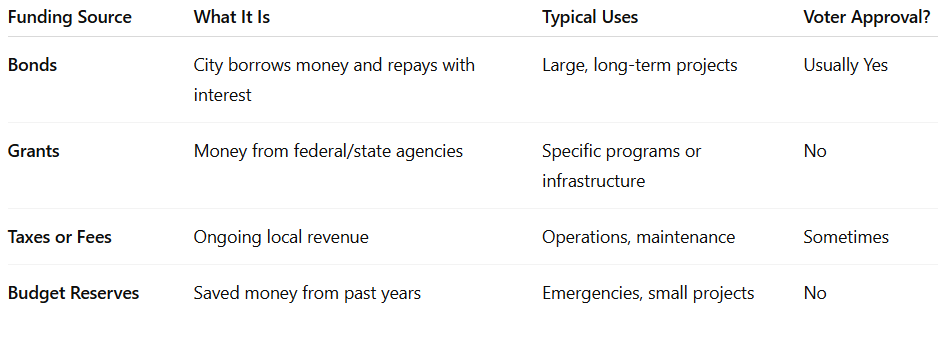
How does the City repay bonds?
The City of New Orleans has a Board of Liquidation of City Debt, which manages our bond sales and repayment. This board is able to direct tax revenues to bond repayment directly before funds are made available for other uses. This is a common practice that makes New Orleans’ bonds a a safe bet for investors, and enables the City of New Orleans to maintain a favorable bond rating (like a credit score) and borrow at a lower interest rates.
What Are the Trade-Offs?
Bonds help cities build what they need now, but they come with long-term responsibilities:
The city must repay the borrowed money with interest.
Debt payments can limit what the city can spend on other needs in future budgets.
Too much borrowing can affect the city’s credit rating.
Still, bonds are usually seen as a responsible and necessary tool for large public investments — when used carefully and with voter oversight.
Before You Vote: A Quick Checklist
Ask these questions when reading any bond proposal:
What projects will this bond pay for?
How will it be repaid — and will taxes change?
How much will the city borrow, and over how many years?
How can I track the progress of the projects?
How does this bond fit into the city’s overall plan for improvement?
In Short:
Municipal bonds are a tool for building the future — they let cities make big improvements now and pay them off over time. As a voter, you decide whether those projects and the costs that come with them are worth approving.